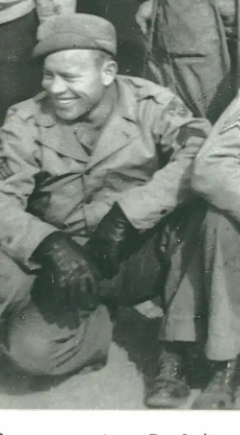
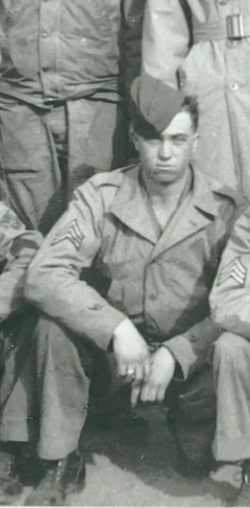
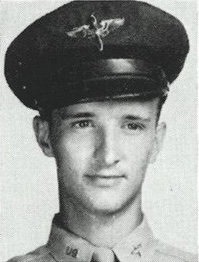
To the men of 1st Lt. James C. Baynham’s crew, 27 September 1944 began like any of the deep-penetration raids the 702nd Squadron seemed always to draw. “The day of the mission came as any other day,” Baynham wrote in 1950, “with getting up early, eating breakfast and going to the briefing room… Nothing out of the ordinary. And taking off, forming, crossing the channel were all routine.” Their B-24H #42–50383 — “King Kong” — flew with the lead group into Germany under solid cloud.
The day’s undoing began at the Initial Point. “The navigator was map reading by radar and made a wrong identification,” Baynham recalled, “so we turned at that point and made a bomb run on a town about 30 miles away from Kassel.” The trailing groups corrected and bombed Kassel; the 445th pressed on alone, far off course. With no flak over the false target, the crew relaxed — “small talk over the intercom, ‘Milk Run,’ ‘Sure an easy one.’” Then co-pilot Charley Bousquet jammed his flak helmet back on: “I looked out my window and saw a mass of fighter planes coming up from the cloud cover below.”
Top-turret engineer T/Sgt. Howard Boldt saw them too. “I called our tail gunner, John W. Knox … He replied, ‘Yes and I hope they are ours.’” They were not. Cannon fire caught the ship between No. 1 and No. 2 engines; the bomb bay caught fire, fed by gasoline fumes. “I looked at the glass in the door to the bomb bay,” Boldt wrote. “It was red as if you were looking into a furnace.”
“I hit the auxiliary bomb door lever. The left two doors opened all the way but the right doors only opened about six inches… As only fumes were burning, opening the doors blew all the flames out. It was at this time that I was hit, breaking both legs, and out I went.” — T/Sgt. Howard Boldt
Baynham held the diving ship steady. “Charley, Boldt and Fields bailed out at 18,000 ft. I stayed in the ship holding it steady until it reached 12,000.” In the waist, the stunned, half-blinded tail gunner Knox was pulled from his wrecked turret and clipped to his chute by waist gunner Ray Lemons; navigator John Cowgill came forward with his face covered in blood and was pushed out the hatch. “Just a few seconds after I bailed out,” Baynham wrote, “I saw the ship explode and go down in pieces.”
Five of the nine lived to be captured. Boldt, both legs broken, hung in a tree for hours before German soldiers carried him out on a litter of his own parachute lines; Knox, blind in one eye, was operated on without anesthetic. But the cruelest fate met the men who reached the ground near Nentershausen: navigator John Cowgill and bombardier Hector Scala were murdered by civilians. The war-crimes record of Scala’s death is stark — he “landed safely, surrendered unarmed,” was forced to run a gauntlet and beaten by seven men, “and was shortly thereafter shot to death.”
Sources: Howard Boldt’s draft 8th AF News article and KMHS narrative; James Baynham’s account (3 June 1950) and 2010 interview with Aaron Elson; John Knox’s roster and 2006 KM Chronicles account; George Collar’s crew sheet; UN War Crimes / POW-MedSearch records; German MACR 9390. KMHS archive.
B-24H #42-50383(Hardstand 32) "King Kong" Call Letter X (X-Ray)
HIGH RIGHT ELEMENT

Crashed in Germany MACR 9390