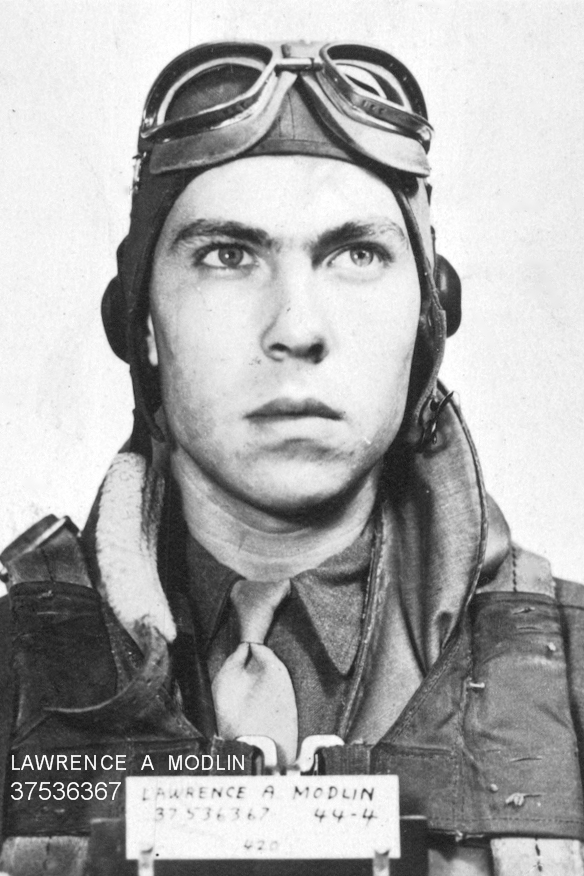
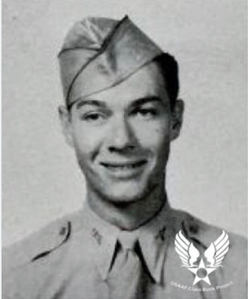
On the morning of 27 September 1944, 1st Lt. Myron H. Donald lifted his B-24 Liberator (42-51287) off the runway at Tibenham as part of the 445th’s strike on Kassel. The crew that day was an assembled one. Their bombardier, 1st Lt. Ira P. Weinstein, had not been scheduled to fly — it was Yom Kippur, and he had a three-day pass in his pocket. He volunteered anyway, hoping to finish his tour and be home for his wife’s December birthday. “I never knew or had met anyone on that crew,” Weinstein recalled. “That’s how I happened to go on the fateful Kassel Mission.”
After bombing, the 445th drifted off course toward Göttingen and, now without escort, was swarmed by roughly 150 German fighters. The German crash record (MACR 9391) fixes the end coldly: the ship went down about 11:03–11:09, cause “by fighters on the return flight,” crashing at Nesselröden, one kilometre northeast on the Ziegenberg.
Inside the burning Liberator, two men barely escaped. Navigator 2nd Lt. Eric W. Smith Jr. felt the bombardier pull him clear: “I helped my bombardier, Lt. Ira Weinstein, out of the nose turret and out the nose wheel hatch. I then grabbed my chest-chute and took the plunge.” Weinstein’s own escape nearly killed him — he had drawn an unfamiliar back-pack chute, and as he dropped through the hatch the straps snagged on the bombsight while the plane fell into a flat spin: “I chinned myself back up into the airplane, undid the strap, and bailed out a second time. By the time I bailed out, I figure I was at the most maybe at 2,500 feet.”
The pilot was not so fortunate. Of the men aboard, only the two Smiths, Weinstein, and Donald cleared the ship; the other six went down with it. Weinstein gave the most direct account of his pilot’s fate: Donald bailed out but was injured on landing, “and pretty soon some farmers came along and they pitchforked him to death.” As a prisoner, detailed by the Germans to recover the dead, Weinstein found his own ship and crew. In Burial Detail he wrote: “I came across the pilot’s body in a ravine about 1/2 mile from the plane. His chute had been cut off of him and he was stripped of all of his flying apparel. His body and face were in a badly mauled condition.” He also buried the five men who burned in the wreck, and after the war sought out the dead men’s parents to spare them the silence of a bare telegram: “those parents must wonder what happened. All they get is a KIA notice, nothing else.”
For more than forty years Weinstein shut the war away — “I have wiped out the war years and the P.O.W. years,” he wrote in 1987 — refusing to own a German car or set foot on German soil. Only in September 2000, at 81, did he return, standing at the reconciliation memorial in the Seulingswald Forest near the field where his Liberator fell. “One can never get rid of the memories,” he told a German reporter, “but one can overcome the feelings.”
Sources: German crash-data sheet, MACR 9391; Ira Weinstein, “Burial Detail” and interview with Aaron Elson; Eric W. Smith Jr., “From the High Right Squadron” (1994); Weinstein, “They Say, You Can’t Go Back!” (KMMA, 2001). KMHS archive.
B-24H #42-51287(Hardstand 29) Call Letter Y (Yoke)
SLOT ELEMENT

Crashed 1 Km Northeast of Nesselroden, Germany - MACR 9391