The day began like most others at Tibenham. “It showed signs of rain as I plodded through the mud from the mess hall to the briefing room,” radio operator S/Sgt. Jack M. Erickson wrote of that morning. When the curtain drew back, the target was revealed as the Henschel aircraft plant at Kassel, and the 445th Bomb Group was to mount a maximum effort — 37 Liberators, with 2nd Lt. William F. Golden’s crew assigned the lead element. Erickson climbed aboard a battered olive-drab B-24H decorated with a devil holding Neptune’s fork, which he believed was “probably one of the oldest Liberators that was still operational in our group.”
Over a 10/10ths overcast, the group missed its initial point, drifted toward Göttingen, and emerged from the bomb run “well out of the main bomber stream…on our own without fighter escort.” Then came the storm. “After about 10 minutes of routine flying we were suddenly attacked by Focke Wulf 190 fighters,” Erickson recalled. “More than 100 FW190s attacked the group from below…in waves 10 planes wide.” He watched a wingman’s Liberator break apart and fall 20,000 feet: “I did not see any parachutes emerge from the flaming pieces.”
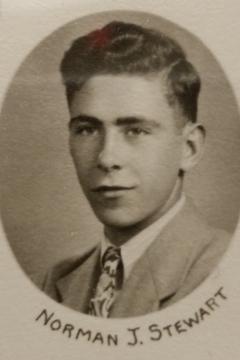
“Suddenly, our plane shuddered as it took hits in the number three engine…a cloud of black smoke pour[ed] out…A few seconds later the plane shook badly as the tail turret took a direct hit by a 20 mm cannon shell. Sgt. Norman Stewart, the tail gunner, was gravely wounded and was removed from the shattered turret by Sgts. Bagley and Feltus.” — Jack M. Erickson
With a wing holed and control wires dangling in the slipstream, Golden and co-pilot Lt. Christie fought to hold the aircraft level. Erickson keyed an SOS on the liaison transmitter, “relaying the destruction of the 445th from the Luftwaffe’s onslaught.” Golden gave the order to bail out. Because the wounded Stewart could not jump himself, the crew “hooked Stewarts parachute rip cord to a static line and dropped him out through the camera hatch.” Erickson found the bomb-bay doors frozen by failed hydraulics and cranked them open by hand: “I edged my way to the emergency crank and began to turn it.”
One by one the crew went out. Erickson climbed beside his pilot a final time: “I told him that everyone else had jumped. He told me to go and I gave him a salute…That was the last time I ever saw him.” Lt. Golden was killed in action. The aircraft came down roughly 2.5 km northeast of Braunhausen, south of Cornberg. Of the 445th’s 37 Liberators, only a handful reached home; the air battle, Erickson noted, “had lasted less than five minutes.”
Sources: Excerpts from “A Wartime Log” by Jack M. Erickson, T/Sgt., 701st Bomb Squadron, 445th Bomb Group; annotated Golden crew photograph; contemporary 1944 press clippings reproduced in the same log. KMHS archive.
B-24H #42-94863(Hardstand 40) "Ole Baldy" Call Letter T+ (Tare)
LOW LEFT ELEMENT

Crashed 2 Km South of Cornberg, Germany - MACR 9395