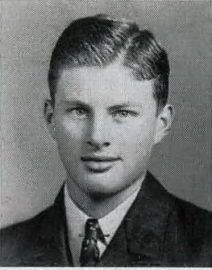
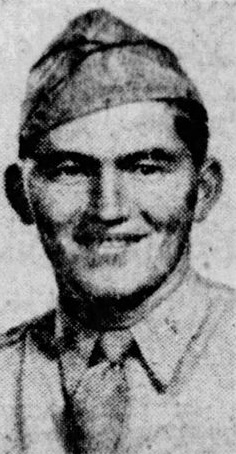
On 27 September 1944, 1st Lt. Paul Swofford flew B-24H #42-51105, “Sweetest Rose of Texas,” on the left wing of the low element of the 445th Bomb Group’s 701st Squadron. It was, as Swofford recalled, only his crew’s seventh mission. His original bombardier, 1st Lt. Augustine “Og” Mandino — later the celebrated author of The Greatest Salesman in the World — was hospitalized that day; a transient nose gunner whose name the survivors could never recover filled the slot. Navigator Henry “Hank” Dobek was aboard for what would be his last flight with the crew before the group’s leadership moved him to a lead crew.
Flying tight formation in a heavy aircraft demanded everything. As Swofford put it, “my concentration is not, ‘Where is the bomber stream going?’ My concentration is, ‘Am I socked in there on the wing of the plane I’m supposed to be dressing off of?’” When the group lead turned at the IP onto a target “several miles northeast of Kassel,” Swofford never knew the formation had strayed: “We didn’t know that we were going astray. But there were people who did, and didn’t do anything about it.”
After bombs away, the group turned off the target with no fighter cover and was struck by more than 100 enemy fighters. “The first thing I knew was I could see several of the other planes just start shredding,” Swofford remembered. Then disaster struck his own aircraft: the No. 2 engine was killed, hydraulics and radio failed, a 20-mm round tore a fist-sized chunk from a propeller blade, and the cockpit windshield shattered. “Both my co-pilot, Ward Smith, and myself got a face full of flying glass. I felt the blood running down my face, and I looked over at the co-pilot; blood is running down his face.” Engineer Phil Vosburgh, seeing only blood, thought both pilots were finished. Radio operator Gene Thum took shrapnel in the leg; Vosburgh applied a tourniquet.
Fearing fighters would finish a visibly crippled bomber, Swofford delayed feathering the dead engine and ordered every red Very flare fired to call back “our little friends.” Unable to keep formation speed on three engines, he firewalled the throttles and nursed the aircraft home alone. Reaching Tibenham, with gear cranked down by hand and no brakes, he was waved off the first approach by a storm of red flares from the tower: “They waved me off at my own base on three engines, back from a combat mission… It’s been 55 years, but I still get angry when I think about it.” On the second approach he put her down: “that airplane just rolled as straight as a die right down the middle of that runway,” finally veering off into soft ground near the runway’s end.
The Society’s crew sheet records the outcome plainly: the aircraft “made it back to Tibenham, but ran off end of runway, due to loss of hydraulic pump in #3 engine, hit by German fighter.” Of 35 bombers that reached the target area, only four returned to Tibenham; Swofford’s was one. He flew again eight days later, completed all 35 missions, and retired a Lt. Col., USAF. Bitterly, he noted that apart from Thum’s Purple Heart, his crew received “not one atom” of recognition: “my engineer and my co-pilot performed valiantly.”
Sources: An Interview with Paul Swofford (Aaron Elson, Lakeland, FL, 19 April 1999); “The Kassel Mission — An Overview” (Paul Swofford, Lakeland, FL, 2004); Paul Swofford — A Brief Bio (2005, updated 2008); Swofford crew sheet; labeled crew photograph; gunners’ Encounter/Combat Forms (Vosburgh, Waller), 27 September 1944. KMHS archive.
B-24H #42-51105(Hardstand 36) "Sweetest Rose of Texas" Call Letter O+ (Oboe)
LOW LEFT ELEMENT

Returned to Tibenham