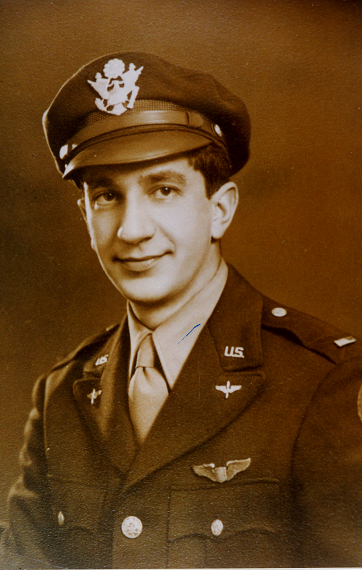
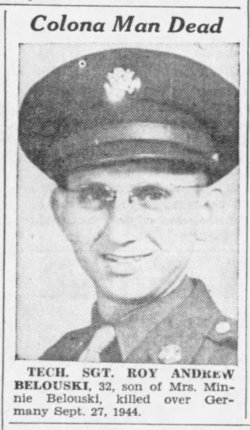
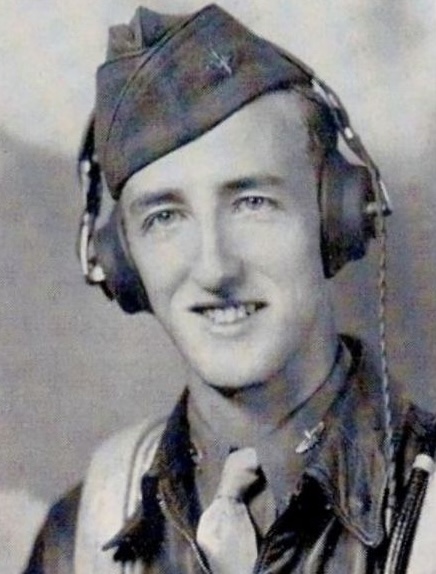
27 September 1944 “began as all the others had,” pilot 1st Lt. Raphael E. Carrow remembered, “being rudely awakened in the earliest hours of the morning. A thick fog reflected the sharp beam of the bicycle light as I pedalled, more intuitively than visually, to the mess hall.” His Liberator, Patches, flew the low-left element in the No. 9 position of the lead squadron — the 445th was the lead group, “the first over the North Sea, the first to cross the mainland.” It was the crew’s twenty-first mission.
Cloud forced a radar drop, and the lead ship veered off course. Carrow saw it at once. “We were supposed to keep radio silence but some of us didn’t,” he recalled. “I was one of those who didn’t. I said, ‘We’re going the wrong way!’” The order came back to stay in line. The 445th bombed Göttingen by mistake, then turned for home alone, fifty miles behind the protected main force. Near Bad Hersfeld some 150 fighters fell on them.
“All around us was fire, black smoke, planes going down, more parachutes… machine guns firing — the shudder of 20mm shells hitting — another engine gone — intercom out — plane out of control — a gripping fear-near panic — then, fire! The bomb bay was a roaring inferno.” — Raphael Carrow, Just Another Rude Awakening
Carrow touched co-pilot Newell Brainard on the arm and pointed to the fire; Brainard left his seat, and Carrow never saw him again. Then came the moment that nearly killed him: “Now I had to find a way out, but I was frozen to the seat!” Unbuckling the belt, shedding flak vest and Mae West — each “presented an alternative death.” That very paralysis saved him. By the time he wrenched free, the aircraft had torn apart: “Instead of the expected inferno, I saw blue sky. The plane had broken in two and the other half had taken the fire with it.” He shoved into space and pulled the cord inside a cloud, breaking clear barely two hundred yards above the ground, the hair burned from the back of his head.
Patches came down at Iba, about 44 miles southeast of Kassel. Carrow landed inside a fenced slave-labor camp, where an elderly guard leveled a rifle and spat one word: “Jude?” Carrow — a Brooklyn-born Jew who never wore dog tags on a mission — said nothing and was marched into the stockade. Five of the nine aboard were killed and four taken prisoner. The cruelest fate fell to Brainard: wounded in the head and first given Red Cross aid, he was taken to the labor camp at Nentershausen, interrogated, beaten, led outside and shot, then buried in a single grave. His family was told only “killed in action” — until German historian Walter Hassenpflug pieced the truth together and his sister read a burial report on which one word “could clearly be read: ‘Murdered.’”
Carrow was interrogated at Dulag Luft — where his recovered flight log had already given the Germans the crew’s names — and imprisoned at Stalag Luft I at Barth. He entered captivity near 180 pounds and left at 120, liberated by the Russians in 1945.
Sources: Raphael Carrow, “Just Another Rude Awakening” (Kassel Mission Reports Addendum, 1994) and Aaron Elson interview (1999); German crash-data form, MACR 9399; Duane Giesler KMHS narrative; Kay Brainard Hutchins, The Palm Beach Post (1992). KMHS archive.
B24J #42-110022 "Patches" Call Letter F+ (Fox)
LOW LEFT ELEMENT

Crashed in Germany - MACR 9399
Five airmen were killed, and the plane crashed at Iba, Germany. The remaining four crewmen were captured and held at Stalag Luft I at Barth, Germany and Stalag Luft IV at Gross Tychow, Poland.
Reference: Carrow crew German crash-data form (PDF) — https://static1.squarespace.com/static/53f7e605e4b0e6c68d78bdc4/t/56baa1deb6aa60f43e8a8182/1455071711631/Carrow+Crew+German+Form001.pdf