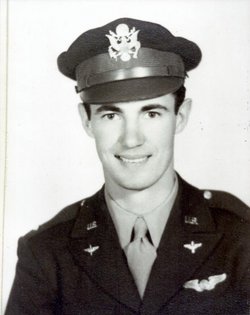
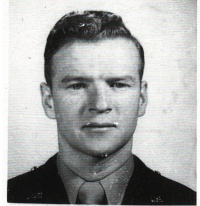
On the morning of 27 September 1944, the crew of 1st Lt. Joseph E. Johnson flew as deputy lead of the 445th in B-24J 42-51342, a Liberator the men called “Fridget Bridget.” Their bombardier, 1st Lt. James E. Dowling, spent the rest of his life insisting on one point: the popular account that the 445th simply got “lost” was wrong. “The conception that we were lost is not true,” he wrote. “We made the I.P. and turned toward the target Kassel.” From over the bombsight he had the tank factory in his sights when the lead crew radioed they were diverting because of cloud. “Johnson tried to tell the lead crew that we had the target. However, this information was ignored.”
After bombs-away the group lost its escort and, some thirty miles on, was struck by a wall of FW-190s. Dowling never forgot the strangeness of it: “It seemed that the cannon fire was frozen in time as the sky lit up with thousands of tiny flashes.” He watched Capt. Chilton’s lead ship begin to maneuver, then “Chilton’s plane blew up as well as one to our right.” Calling a target to his nose-turret gunner, he saw the result: “I called to William Flickner, who was in the nose turret, that a FW 190 was directly below us. He pointed his 50 caliber guns down, and I could see stitches all over the wings and it spun in.”
On the second pass the No. 3 engine was shot out and 20mm fire cut down navigator 2nd Lt. Herbert Bateman, seated directly behind Dowling. In his account “Too Busy,” Dowling recalled warning Bateman to put on his chute: “He acknowledged and stated he was too busy at the time.” When the nose doors gave way and Bateman fell, Dowling tried to save him:
“I spun around and grabbed him by the legs but due to the lack of oxygen and the tremendous tug of the slipstream, I was unable to pull him back into the ship. He fell out without his chute. As far as I can determine, he was already dead from wounds caused by the 20mm.” — 1st Lt. James Dowling
Hit in the back, Dowling clipped on his chest chute and rolled out the nose-wheel opening, coming down near Bad Hersfeld — among the first of the group’s men captured. The Liberator went in at Breitau, about a kilometre north of the Erbberg. Only Bateman was killed in the air; Johnson, Dowling and the others became prisoners. But nose-turret gunner 2nd Lt. William Flickner, who survived the bail-out and evaded for ten days, was captured near Nenterode and shot by a country constable “while attempting to escape” on 7 October — one of several Kassel airmen murdered after capture.
James Dowling carried Kassel home to Smithtown, New York, where he became Highway Superintendent. In 1987 he returned to Germany and met historian Walter Hassenpflug; it was then the airmen learned their missing comrade’s fate. “It took 43 years,” Dowling told the local paper, “but now we know what happened.” A decade later he and his wife Dorothy were guests of honor at Tom Brokaw’s Greatest Generation book party — a 445th bombardier standing for a whole generation.
Sources: German crash-data sheet, MACR 9392; James Dowling letter to Walter Hassenpflug (1987) and “Too Busy” (8th AF News); Dowling casualty questionnaire; The Smithtown News (1987); 2nd ADA Journal (1998–99). KMHS archive.
LEAD ELEMENT

Crashed 1 Km North of Breitan, Germany - MACR 9392