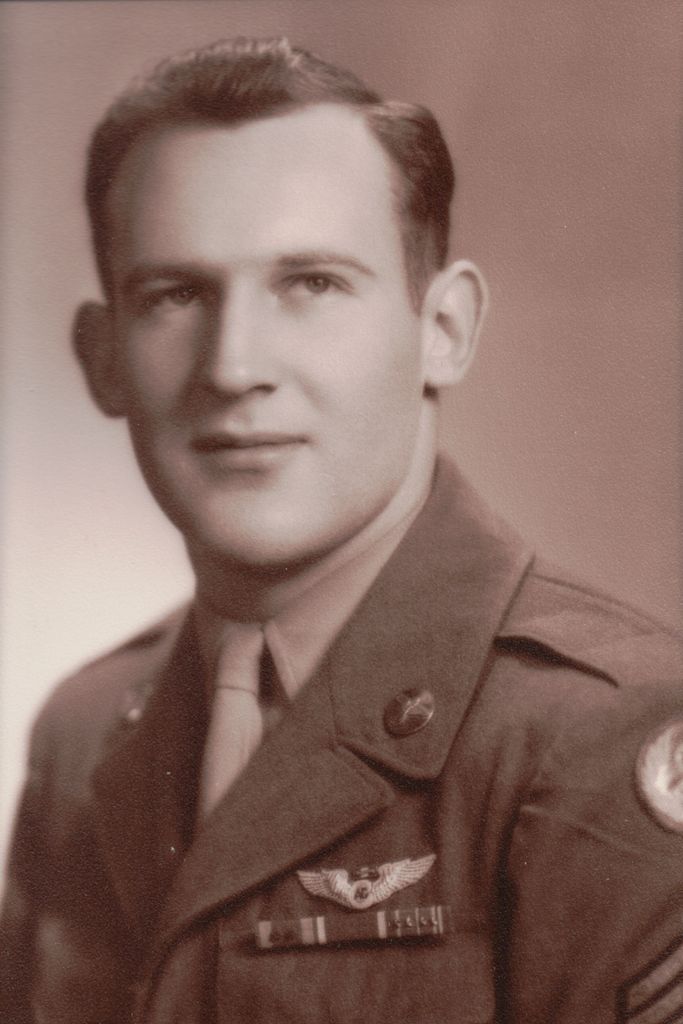
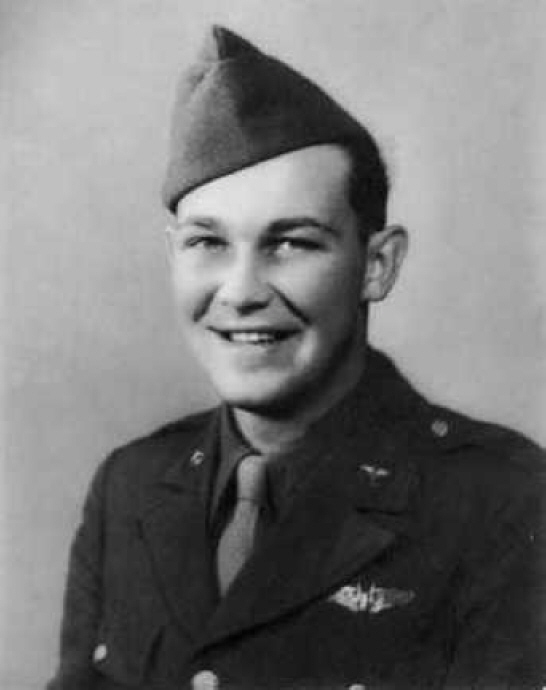
At roughly 7:15 on the morning of 27 September 1944, 1st Lt. Richard A. Fromm lifted B-24H Liberator #42-51080 off the runway at Tibenham, bound for the railyards of Kassel. He was twenty-one, a former University of Tennessee basketball standout who had turned down professional offers to enlist — close to six-foot-three, tall enough that German witnesses would later remember the “noticeably taller” airman among the fugitives in their woods. Among his nine crewmen was a gunner who may have been the youngest man on the entire mission: nose-turret gunner S/Sgt. Raymond Bence Jr., who had turned nineteen exactly one month before.
Over the target the 445th’s aircraft, drifted off course, were ambushed and shredded. The German crash record (MACR 9762) lists the cause bluntly: durch Jäger beim Rückflug — brought down by fighters on the return flight. Heavily damaged, Fromm’s ship drifted northwest. He gave his men what every bomber pilot prayed he could give: time. He held the dying aircraft steady and sounded the alarm early, so the crew could bail in order rather than in panic.
They went out in sequence. Radio operator Joseph Rackis and copilot Edward Globis dropped through the bomb bay one behind the other; the researcher Walter Hassenpflug recorded that “Globis had patted the man in front of him on the shoulder reassuringly … meant as an encouraging gesture.” In the waist, gunner Joseph Williams had been badly wounded and could no longer move; William Brower and tail gunner Lee Coffin “ran back, pulled him out, hooked him to the clip and pushed him out, hoping he could pull the cord.” The empty Liberator flew on another seventeen kilometres and exploded at low altitude about 400 metres south of Reichenbach (today part of Hessisch Lichtenau).
Of the ten men, all bailed out alive but one. Globis’s parachute failed to open; he was found dead in the farmland near Ulfen and buried in the village cemetery — the crew’s only fatality. The survivors were hunted down over days and weeks. Fromm’s war was only beginning: he and 2nd Lt. William Flickner of the Johnson crew fled together through the forest toward the American lines; captured once, Fromm escaped and was recaptured, while Flickner later broke away and was murdered by a rural policeman. Fromm pressed on alone, finally arrested on 21 October near Leimbach — some fifty kilometres covered over twenty-four days of evasion, spotted by a boy on his way to the train station.
As a prisoner at Stalag Luft III, Fromm spent his captivity, his daughter wrote, “digging tunnels underneath the POW camp.” After the war he stayed in uniform, flying B-29s and B-52s in Korea and Vietnam and retiring a lieutenant colonel in 1975; he died of leukemia in 1978 and was buried at Andersonville National Cemetery. His son Martin remembered the crew with a plain awe: “I say men and I mean men — but really, they were so young.”
Sources: German crash-data sheet, MACR 9762; Walter Hassenpflug, “Failed Escape Attempts (Flickner–Fromm)”; Raymond Bence Jr. letters (1991) and 2nd ADA Journal (1992); Joseph Rackis letter; Brower and Coffin family accounts; Carol and Martin Fromm emails (2005, 2011). KMHS archive.
B-24H #42-51080 (Hardstand 20) Call Letter U (Uncle)
SLOT ELEMENT

Crashed 400 meters South of Hessisch Lichtenau-Reichenbach, Germany - MACR 9762