On the morning of 27 September 1944, 1st Lt. Carl J. Sollien lifted B-24H “Fort Worth Maid” (42-50321) off the runway at Tibenham with the 702nd Squadron. Sollien was a man apart — a professional photographer from Hamilton, New York, and a pianist and composer whose playing at the Officer’s Club was so admired that the group’s former squadron commander, the actor James Stewart, “enjoyed Carl Sollien’s piano playing” whenever he returned to the 445th. Lead bombardier Lt. Malcolm MacGregor, who flew in Sollien’s nose that day, called them “a really sharp crew.”
The mission began as a milk run. Then the lead navigator drifted miles off course, the group bombed an open field instead of the target, and — just as the P-51 escort peeled away — a German storm group of some 150 fighters fell on the strung-out formation. Number 4 engine caught fire. Radio operator T/Sgt. Charles Graham saw the moment control was lost: “I saw Carl Sollien pull the control back and it all came right back in his lap. So he had no control over the ailerons or rudders.” The ball turret had been stripped out weeks earlier to save weight, leaving the belly blind; the fighters came up from below, and, MacGregor said, their first object was “to kill the gunners in the back of the plane — and that’s what happened in our plane; they were all killed.”
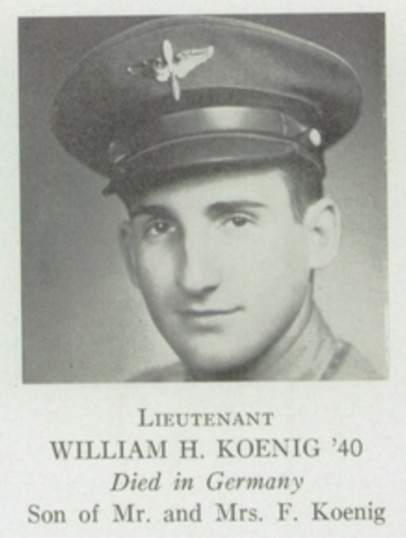
Co-pilot Lt. William Koenig bailed out, but his back-pack chute never opened; he was found dead near the wreck with a single mark on his chin. Pilotage navigator Lt. John Dent — flying that day only to gain experience — never got out of the nose. The ship came down about a mile and a half west of Herleshausen, near the Werra; a surviving photograph shows a German soldier and a small child picking through the scattered aluminum.
“Smoking oil so thick you couldn’t breathe… Sir, you’re under arrest.” — navigator Lt. Wesley Hudelson, recalling his escape from the spiralling fuselage and his capture in a tree
MacGregor, riddled with thirteen pieces of shrapnel and a wrecked ankle, drifted into a plowed field amid “extreme loneliness.” On the ground, civilians were as great a danger as the battle: the survivors were marched in lines, spat on, stoned and struck — “the civilians would have killed us all if it hadn’t been for the German soldiers protecting us,” Hudelson remembered. Five of the day’s downed 445th men were murdered by civilians. Sollien, drafted into a German burial detail, wore the overseas cap of a dead waist gunner to silently signal Graham which of the crew had been lost. Five of the ten aboard were killed; five became prisoners.
Carl Sollien stayed in uniform, retiring a lieutenant colonel with Strategic Air Command. Thirty-five years on, the anger had not cooled:
“It is especially galling to me that my last combat mission was, in my mind, an incredible, useless, devastating fiasco… Only us, who survived the awful shellacking, can feel anything.” — Lt. Col. Carl J. Sollien, 1979
Sources: Carl Sollien letter (1979); Malcolm MacGregor oral history (Univ. of Utah, 2002) and Aaron Elson interview; Charles Graham interview (Aaron Elson, 1999); Wesley Hudelson recollections (2011). KMHS archive.
B-24H #42-50321(Hardstand 25) "Fort Worth Maid" Call Letter V (Victor)
LEAD ELEMENT

Crashed 1.5 Km West of Herleshausen, Germany - MACR 9911