
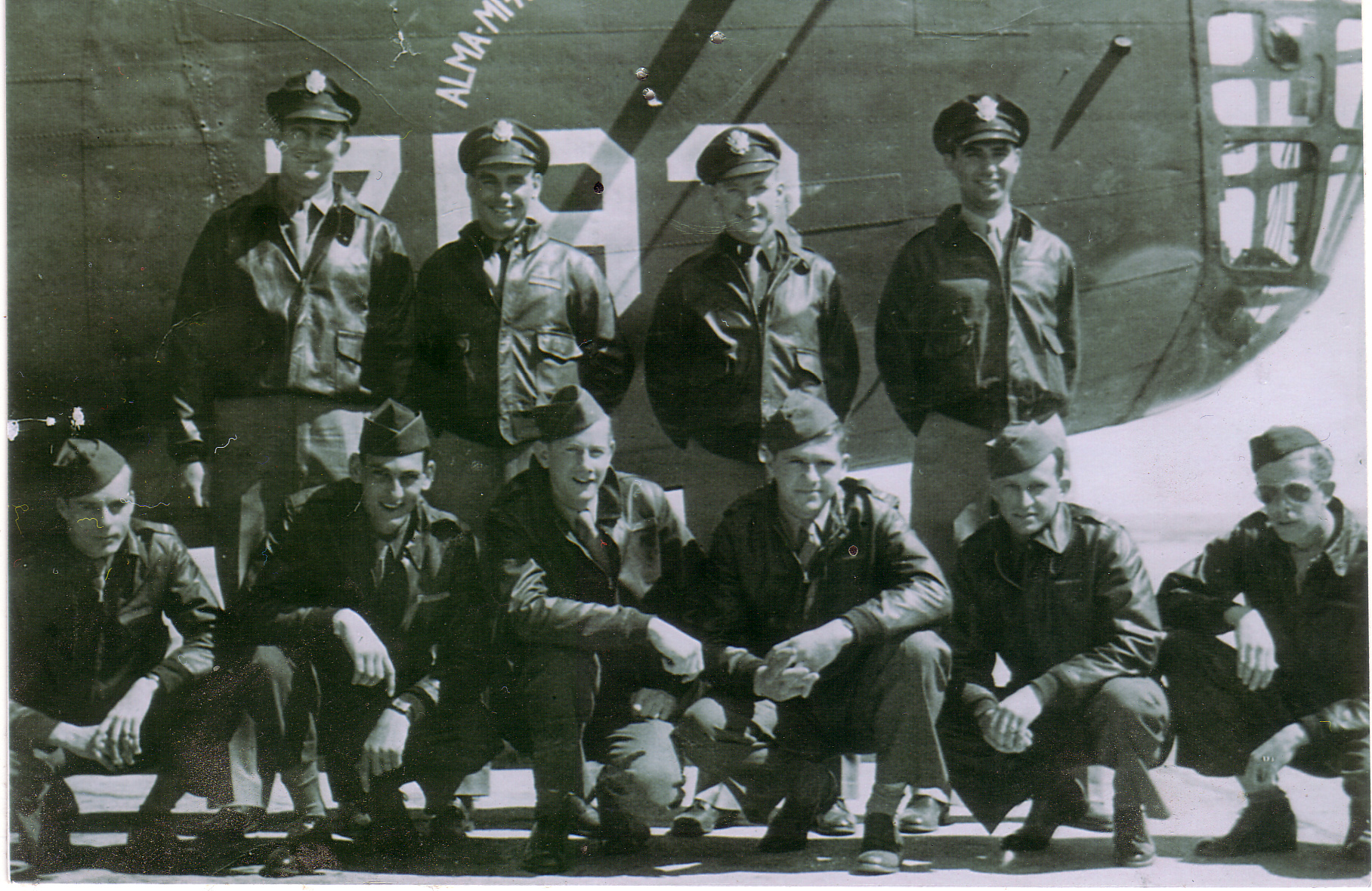
At 10:16 on the morning of 27 September 1944, 1st Lt. Jackson C. Mercer banked B-24J #42-51549 — “G for George” — away from the target and into history. “And there we were — 26,000 feet, 10:16AM, September 27, 1944, somewhere south of Kassel, Germany flying above a 9/10 overcast — and then ‘BOOM!’” he wrote. His 703rd Squadron ship, flying the left-wing slot on the wing of squadron leader Cecil Isom, had just survived the bomb run when an “unbelievable catastrophe” opened in the sky to its right.
A navigation error had carried the 445th alone over Germany, stripped of escort, and 150 or more fighters fell on the group. Tail gunner Harry Lied broke in: “Bandits at six o’clock level, ten or twelve across… They’re firing — looks like their wings are on fire, they’re closing fast—” and the intercom went dead. Co-pilot Leo Pouliot remembered it plainly: “Looking to the right, I saw just plain hell. Planes were going down — some in flames, others just exploding. The air was full of 20mm shells.” Within minutes only Isom’s and Mercer’s ships of the 703rd remained.
The crew fought back ferociously. When a fighter hung firing on Isom’s ship, nose gunner Ted Hoiten “was upon him with his guns blazing … The fighter caught on fire, fell over on its back, and went down.” Engineer Kenneth Kribs swung the top turret around “in a violent maneuver,” held a long burst, “and then suddenly the fighter just disappeared in a cloud of debris.” In the right waist, bombardier George Noorigian downed a Focke-Wulf 190 of Göring’s “Yellow-Nose Squadron.” All told the crew was credited with five fighters destroyed and two probables.
The cost was staggering. A burst of four 20mm shells walked across the ship: one blew apart the twin tail; one detonated in the chaff box Noorigian sat on — “it’s a lucky thing I’m still here.” Shells ruptured oxygen bottles, severed control cables, shot away the rudder, and holed a wing tank that streamed fuel through the bomb bay. With no rudder, no radio, no hydraulics, Mercer engaged the autopilot and nursed the wreck toward the RAF emergency field at Manston, flying the ailerons while Pouliot worked the autopilot for the rudders. As they touched down, a small New Testament radio operator Robert Bennett kept in the equipment fell on him — “We felt even more assured when a small Bible fell on Bob Bennett when we touched down.”
The Manston depot logged more than 300 items of battle damage across six pages — over 250 shrapnel holes and, in the No. 2 gas tank, an unexploded 20mm shell. “If it hadn’t been a dud,” Pouliot wrote, “we’d never have come back.” Noorigian put it more simply, scrambling out: “It’s the first time I ever kissed the ground.”
Sources: Jackson Mercer, “Next To Last and then — Home” (KM Reports Addendum, 1994); Leo Pouliot, “Fire Fight” (8th AF News, 1989); George Noorigian interview with Aaron Elson (1999); Mercer crew sheet. KMHS archive.
B-24J #42-51549 (Hardstand 13) Call Letter G (George)
LEAD ELEMENT

Force-landed at Manston Emergency Field, Kent, England
