
Winter 1997/1998 edition. The missions Jimmy Stewart flew with the 445th; Web Uebelhoer's firsthand account "Bomber Pilot Recalls Disastrous Kassel Raid"; the election of the new Kassel Mission Historical Society officers at Harrisburg; "Building a Memorial of Hope" on Walter Hassenpflug and the German-American memorial; Doug Collar on "The Best Years of Our Lives"; and Frank Plesa's tail gunner's account.
Download the original newsletter (PDF)THE KASSEL MISSION CHRONICLES NEWSLETTER — WINTER 1997 / 1998
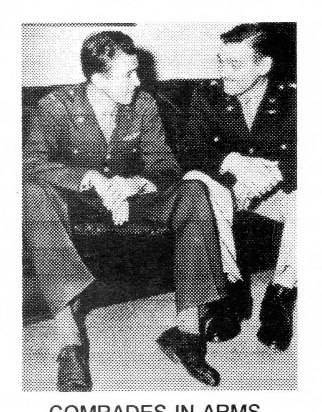
MISSIONS JIMMY STEWART FLEW WITH THE 445TH — by John Harold Robinson, 703rd Bomb Squadron, from “Tennessee Flyover”
THERE WERE MANY EVENTS and quotes during the period that I was associated with Jimmy Stewart, from 1 September 1943 to 31 March 1944, when Stewart was transferred to the 453rd BG as their Group Operations Officer. While Stewart was Squadron Commander of the 703rd, you didn’t know until the last minute of briefing or when getting on the truck to go to the aircraft whether Jimmy Stewart was going to fly the mission. He would just come out dressed and get in one of the trucks. We arrived in Tibenham, England, Station 124, APO 558, on 25 November 1943.
13 December 1943—Target: Kiel, Germany. Jimmy Stewart flew his first mission as co-pilot on Lt. Cook’s A/C 42-75559. My crew did not fly this mission.
William R. Dewey, President — P.O. Box #413, Birmingham, MI 48012
George M. Collar, Vice President-Historian — 399 Melmore Street, Tiffin, Ohio 44883
Reginald R. Miner, Vice President — 1084 W. Lake Road, Branchport, NY 14418
Frank J. Bertram, Director — 20016 Greenview Drive, Woodbridge, CA 95258
Henry W. Dobek, Director — P.O. Box 624, Naples, ME 04055
Web Uebelhoer, Director — 14108 Circle Ridge Drive, Sun City West, AZ 85375
KASSEL MISSION CHRONICLES NEWSLETTER — William R. Dewey, Editor. Mary Beth Barnard, Contributing Editor. George M. Collar, Contributing Editor.
The Kassel Mission Memorial Association was incorporated in the State of Michigan 16 May 1989 as a non-profit corporation, and was certified as a Federal Income Tax-exempt 501(c)(19) Veterans’ Organization 29 Jan 1990. Purposes of the Kassel Mission Memorial Association are: 1. To perpetuate and promote the memory and history of the Kassel Mission of 27 September 1944 by the 445th Bomb Group of the 8th Army Air Force, 2nd Bomb Division, 2nd Combat Wing. 2. To fund and dedicate one or more memorials to the Kassel Mission at appropriate locations. 3. To publish and promote books, articles, and video productions about the Kassel Mission and the 445th Bomb Group, Tibenham, England, in World War II.
ON SATURDAY, SEPTEMBER 27, 1996, members of the Kassel Mission Memorial Association met at the Harrisburg-Marriott Hotel and unanimously elected the slate of officers proposed for the new Kassel Mission Historical Society. It was proposed and accepted that the Kassel Mission veterans comprising the Memorial Association continue with their sons and daughters, in order to insure continuity of the goals and purposes of the new organization.
OFFICERS — William R. Dewey, Chairman; Dr. Douglas E. Collar, President; Reginald Miner, Executive Vice President; George M. Collar, Vice President-Historian; Ira Weinstein, Vice President-Membership; Marilyn S. Dewey, Secretary-Treasurer. DIRECTORS — Frank Bertram, Jim Bertram, Hank Dobek, Jim Dowling, Reggie Kitchens, Ray Lemons, Jima Schaen Sparks.
About fifty members attended the meeting, and heard the Treasurer of KMMA, Marilyn Dewey, report that KMMA is free and clear of all obligations and that over $7,000 is in the KMMA money market account. All funds will be rolled over into KMHS upon receipt of IRS approval, expected by midsummer, 1998. The meeting was adjourned by Doug Collar, President of the new KMHS.
Because of the tremendous demand for hotel rooms next fall, and the large number of groups planning to attend the Mighty 8th Heritage Museum at Savannah, it was decided to postpone the next KMMA/KMHS meeting until September, 1999. We encourage all Kassel Mission veterans and families to attend the 2nd Air Division National Reunion to be held over next Memorial Day weekend, May 22-25, 1998, at Oakbrook, Illinois. Kassel Mission veterans will be honored at that Reunion.
R.F. (Dick) Gelvin is doing an excellent job of compiling a complete roster of all troops that served in the 445th BG during WWII. So far he has listed 93 pilots in the 700th BS, 83 in the 701st, 91 in the 702nd, and 92 in the 703rd. Ground crew seems to be the problem. Dick has lists of 1,981 names with no job classification shown.
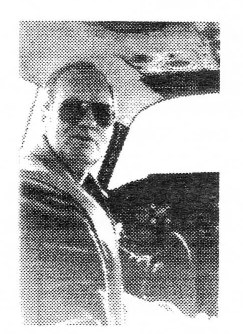
By William R. Dewey, Editor. It was decided at the Harrisburg East/Midwest Regional 2ADA Reunion last September 27th to integrate the veterans with the sons and daughters of Kassel Mission survivors, in order to assure continuity of the goals of KMMA, which in turn become the goals of the new KMHS organization. KMHS was chartered as a non-profit corporation in the state of Michigan on October 17, 1997, but we must wait for IRS approval in order to get full federal tax deductibility.
More than ever, it is important that the Kassel Mission be recognized as a military disaster like the Charge of the Light Brigade, Custer’s Last Stand, and Pickett’s Charge at Gettysburg. Along those lines, my wife gave me a great book for Christmas—“The Guinness Book of Flying Blunders”, by Geoffrey Regan. No, the Kassel Mission is not mentioned—but it should be. He is critical of Brigadier General Uzal G. Ent and Colonel Compton for pulling rank on a second lieutenant navigator, who pointed out that they were following the wrong railroad track, since it led away from Ploesti, rather than toward it! Certainly this is similar to the navigators in the lead of the 445th on 27 September 1944 who called attention to the gross navigational error made in turning toward Göttingen.
NEW BOOK: “OVER HERE” — The Americans in Norfolk during World War Two. Steve Snelling of Norwich’s Eastern Daily Press has put together this 204-page compilation of “the friendly invasion” of East Anglia. The over 250 pictures cover all phases of life and death of the Yanks that populated the English countryside around Norwich. Your order for $35 plus $3 shipping = $38.00 includes a tax-deductible contribution of $8 to the Kassel Mission Memorial Association. Send your check to: KMMA, INC., P.O. Box #413, Birmingham, MI 48012.
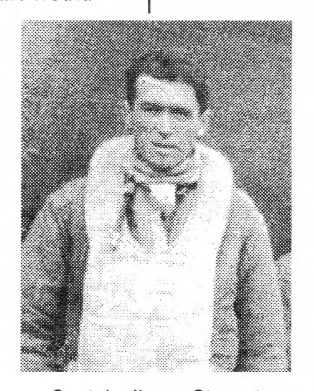
(Continued from page 1, Missions Stewart Flew.) On the following missions, Lt. George Wright’s crew (my crew) flew in a position either under or behind Jimmy Stewart’s aircraft tail or on his left wing. Stewart would tell Wright to stay out of his tail. The missions: 16 December 1943, Bremen — “What a mission.” 30 December, Ludwigshafen (one lost). 5 January 1944, Kiel (one lost). 11 January, Meppen (Brunswick). 29 January, Frankfurt. 4 February, Russelsheim. 8 February, Watten, France. 20 February, Brunswick (Stewart flew as Flight Commander; 3 lost). 25 February, Nurnberg (Stewart flew lead). 18 March, Friedrichshafen (two lost).
James M. Stewart was promoted to Major in January, 1944, and was transferred to the 453rd Bomb Group as Operations Officer 31 March 1944. At that time in the 703rd there were 71 officers and 433 enlisted men, fifteen aircraft under Jimmy Stewart’s command.
From “The Arizona Republic”, Monday, 21 July 1997. Col. Jimmy Stewart sickened by huge loss of lives. Sun City resident Web Uebelhoer flew in one of the most infamous air raids in U.S. Air Force history. By Web Uebelhoer.
It was SEPTEMBER OF 1944. The 445th Bomb Group, 35 aircraft strong, took off from our base at Tibenham, England, in the early morning hours. Our target was Kassel, Germany — the Hermann tank factory. My crew was assigned to the deputy group lead. Over Europe we were greeted by a solid cloud mass at 6,000 feet. To confuse their radar, we dropped clouds of tinfoil strips. Things began to go wrong: our radar officer notified me that the lead aircraft wasn’t flying the proper course. We found out later that we had missed our target completely. When we completed our run and dropped bombs, we found we were alone — we had lost our bomber stream.
...and our “little friends”, the fighter escort, had lost us. John Hubitze, tail gunner, called to inform me there were all kinds of aircraft behind us. Far from friendly — we were being attacked by an estimated 150 Messerschmitt 109s and Focke-Wulf 190s. The first indication was bursts of cannon fire exploding in front of us. The next item that demanded my attention was our lead ship, in serious trouble; I could see the command pilot, Maj. McCoy, trying to signal me as the big bird slowly began to roll to the left and started down.
I was now the leader. We were saved by four P-38’s. Five aircraft were all that remained of the more than 30 that had taken to the air. One would not make it home. Three of us made it to our hardstands. My ship was hit by a 20mm cannon shell that passed through the oil supply for the No. 2 engine; the self-sealing reservoir worked, and no oil was lost. This, I am told, was the worst air defeat the U.S. Air Force experienced.
When I was dismissed from the debriefing room, among those who gathered was a respected member of the 445th — Col. Jimmy Stewart. He took it pretty hard. He was deeply affected, as we all were, by the loss of approximately 250 young men in such a short period of time. The next day the group put up 10 aircraft and went to Kassel again; I chickened out of leading. Six days later, my crew and I led another raid on Kassel. There were no losses in that raid.
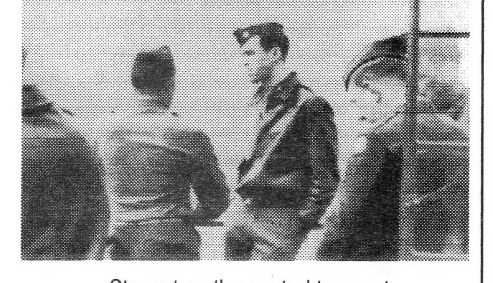
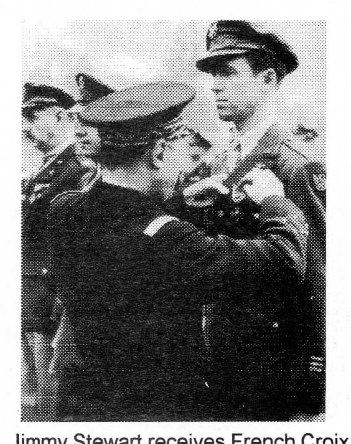
by William R. Dewey. While Jimmy Stewart did not fly on 27 September 1944, he was closely involved. When the four Libs of the 445th landed at Tibenham — all that returned of the 35 — Stewart flew over from wing headquarters to assist in the interrogation of the aircrews. Major Don McCoy, command pilot for the 445th who was killed on the mission, was a close friend and peer of Stewart’s. The Luftwaffe had hardly been seen by the 2nd Combat Wing since the 24 February 1944 Gotha Mission, when the 445th lost 13 bombers. Yes, Jimmy Stewart was involved in the aftermath, and the disaster obviously had a profound effect upon him.
Dear Bill, You may not remember me, but I flew on many missions with you in a plane named “Patches”. Lt. Raphael Carew and I alternated in this plane until he drew the “short straw” on 27 September 1944. I flew the plane the next day (one of ten) back to Kassel. What sticks out in my mind was the next morning when I went down to the flight line and there were 300 abandoned bicycles. Harold Parsons, my navigator, told me we took off the chimney of the house at the end of the runway on a mission with four 2000# bombs. — Don Baumler, Clarence, NY.
Christmas cards were received from Walter and Liesel Hassenpflug, from Gunter and Trudie Lemke, and Walter Hein. Our Belgian friend, Luc Dewez, sent a picture of the cross at Ardennes National Cemetery in Belgium where my first copilot, William L. Boykin, Jr., is buried. Lt. Boykin was killed by German fighters at Misberg on 26 November 1944.
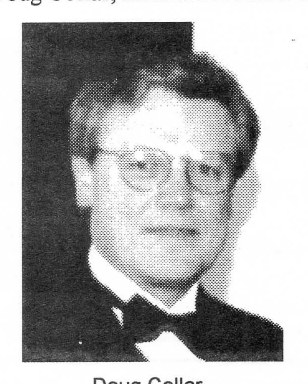
by Doug Collar, KMHS President-Elect. Lately I’ve been reading McKinley Kantor’s verse novel GLORY FOR ME, the source for the Oscar-winning 1946 film, THE BEST YEARS OF OUR LIVES. Most importantly, for me, a 1946 vintage baby boomer and son of a Kassel Mission survivor, Kantor’s novel reconnects me to those epic years of transition from war to peace. Kantor writes: “He walked the road in chilly darkness. Over Vegesack he saw Gadorsky’s fort go down.”
“When you came out of War to quiet streets / You lug your War along with you. / You walk a snail path. / On your back you carry it.”
Over fifty years after the fact, Kantor’s moving verse reminds us that there was not only courage in the skies and fields of battle but also in carrying out productive lives after the war for those who came home. So it is that the veterans of the Kassel Mission and their children today strive to understand the meaning of the events of September 27, 1944 — remembering and never forgetting those young men who had no homecoming. May 1998 bring health, happiness, and peace to all in the KMHS extended family!
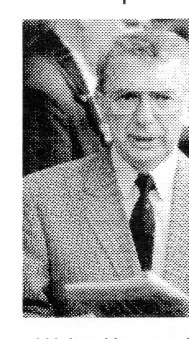
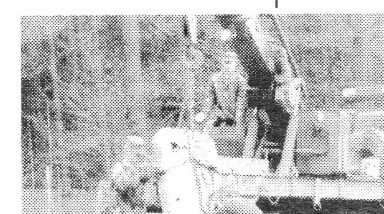
By Thomas Beldon, “Army Times”, 17 November 1997. The Hessen Forest in the Kassel region of central Germany has a memorial marker that is unique — purported to be the only one of its kind in the world, built by former adversaries and dedicated to both the German and American dead of a World War II air battle. Behind the story is the tale of a remarkable man named Walter Hassenpflug and a letter that beat the odds.
Hassenpflug is a historian and humanitarian who believes we all can learn from the past. He earned the Federal Meritorious Service Medal, Germany’s highest award for civic action, for his decades of research credited with making the Kassel Mission Memorial marker a reality. Hassenpflug was 12 when the short air battle took place over his village. The young boy helped capture a wounded American officer after the battle. Weeks later, his parents were killed in another bombing raid. Years later, as an adult, his letter-writing campaign finally hit pay dirt when a chance letter led him to the former U.S. airman he had helped capture.
The president of the Kassel Mission Memorial Association, an American named William R. Dewey, suggested that a battle monument be built in Germany. The spot chosen was the final resting place of the ill-fated lead bomber, a Liberator piloted by the group leader, American Capt. John W. Chilton. The German state of Hessen donated the property; the U.S. Army provided heavy equipment; a local German construction company donated the stone. The memorial was dedicated in 1990 in a joint German-American ceremony when members of the 445th Bomb Group met their former Luftwaffe fighter-pilot enemies in a gesture of friendship and reconciliation. Thomas Beldon is a free-lance writer, an ex-U.S. Marine, who lives in White Pigeon, Michigan.
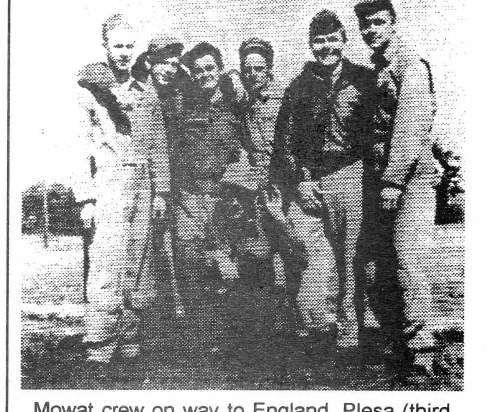
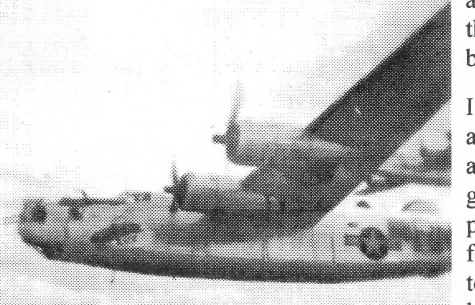
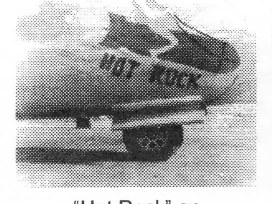
by Frank Plesa. IT SEEMED TO ME that most of the damage was from under at first. I recall seeing the small bursts of orange with grey puffs of smoke like flak all around us for at least thirty seconds before I saw fighters firing from six o’clock level. Our antenna cable was dangling behind my tail turret and the intercom was out. I heard T.J. Myers, engineer/top turret, call out, “What is that? Flak?”, then “Fighters, six o’clock!”
I noticed a FW190 to my right, fifty feet off his wing tip. He was throttled down and firing his cannons at the bomber in front of him and at us. I could see his blue eyes, the big black cross on his right wing and his guns blazing yellow fire. I raked his front fuselage with bursts for three to four seconds. Then I felt a shell hit under my turret, near my right foot; another a split-second later on the left side. This shell bent the left gun up and blew out the windows and me, all at the same time. I felt as if a horse had kicked me in the chest.
What I feared most came next — the plane was on fire and burning throughout. The flames came like a blowtorch. I covered my face, feeling the intense heat. I thought of my parents, loved ones and God. I felt a hand on my shoulder and saw a vision of a white robe. I felt and heard a big puff, then everything went black. I could feel the cold air and tumbling about. My burned right hand pulled the rip cord. I looked up and saw the chute had opened. I noticed high power lines, a forest and a farm house near a pasture. I landed hard. A woman came out and put me in a barn with hay; she looked at my chest wound and said, “Gott.”
The German GIs took me by horse and buggy to Hersfeld train station. That evening I was in a hospital with nuns in white giving first aid. I was then transported to an Allied POW hospital near Memmingen, where British doctors closed my chest wound. I healed slowly; several burns required skin grafts. The first part of February, I was in Luft IV. The most difficult part of POW life was the forced march to keep away from the Russians. We were liberated May 2 by the British Second Army — the happiest day ever. I was a very fortunate and lucky nineteen-year-old airman and will never forget the crew. (Sgt. Frank Plesa, 703rd Sq., Lt. William Mowat’s crew, was the tail gunner on “Hot Rock.” Excerpt from a letter to Mary Beth Barnard.)
KASSEL MISSION SURVIVORS TO BE HONORED. It is now official! Kassel Mission Survivors will be introduced and honored with a certificate at the 2nd Air Division Association 50th Anniversary Reunion at Oakbrook, Illinois at the Awards Ceremony, Saturday, May 23, 1998. Evelyn Cohen, 2nd Air Division Vice President, has advised your editor that you and your families will be treated with great respect at the Reunion.
Text and photographs recreated from the original newsletter; some scanned text may contain minor OCR artifacts. The complete original is available as the linked source PDF above.